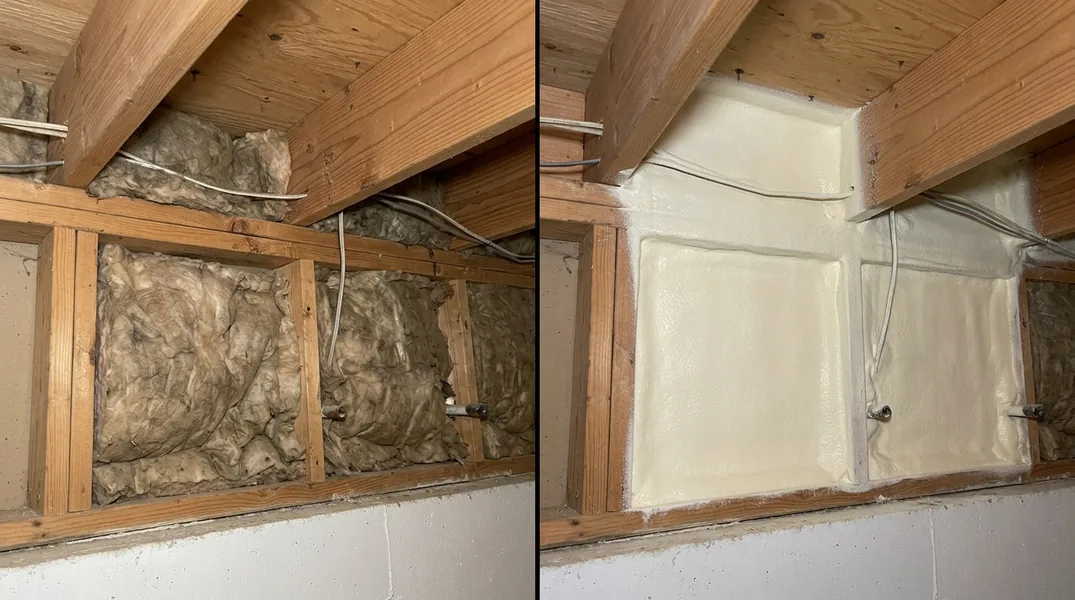
Why Mid-Century Attics in Colorado Springs Fail
If your home was built in the 1950s or 1960s, your attic likely tells a story of decades of settling, moisture, and thermal loss. Mid-century construction in Colorado Springs often relied on fiberglass batts or cellulose that have compressed over time, leaving significant gaps and thermal bridging at the joist cavities. This isn't a sign of poor original craftsmanship; it's simply the reality of how traditional insulation materials age in our high-altitude, temperature-swinging climate.
The problem compounds when you consider Colorado Springs' elevation (over 6,000 feet) and seasonal extremes. Winter temperatures plummet, and summer heat radiates intensely. Your flattened attic insulation can no longer maintain the R-value it once offered, and air infiltration through unsealed joist cavities, rim joists, and penetrations becomes a major energy drain. Many homeowners don't realize that a 40-year-old attic insulation system may be performing at only 60 to 70 percent of its original efficiency. The result: higher heating and cooling bills, uneven room temperatures, and potential ice dam formation in winter.
Spray Foam vs Blown In Insulation: Which Wins for Attics?
When comparing spray foam vs blown in insulation, the differences become clear once you understand how each material behaves over time. Blown-in cellulose and fiberglass are loose-fill products that settle under gravity and vibration. In a mid-century attic, you may have already experienced this settling firsthand. Over 20 to 30 years, these materials can compress by 15 to 20 percent, reducing their effective R-value. They also offer zero air-sealing capability, meaning air leaks around joists, electrical boxes, and ductwork continue unchecked.
Attic Spray Foam Insulation, by contrast, expands to fill every cavity and crack, creating a monolithic thermal and air barrier. Unlike blown-in products, spray foam doesn't settle. It maintains its R-value for the life of your home, and it simultaneously seals air leaks that would otherwise undermine your insulation performance. For a mid-century attic with compromised structural integrity and multiple penetrations, this dual-action benefit is transformative. You're not just insulating; you're also air-sealing in one application.
Spray Foam vs Fiberglass: The Long-Term Performance Story
Fiberglass batts were the standard in mid-century home construction, and they remain popular today because they're inexpensive and easy to install. However, spray foam vs fiberglass reveals a significant gap in long-term performance, especially in attic applications. Fiberglass batts rely on trapped air pockets for insulation, but they're vulnerable to moisture, settling, and thermal bridging where they contact wood framing. In Colorado Springs' dry climate, moisture isn't always the primary concern, but thermal bridging absolutely is. Every joist, every rafter, and every beam conducts heat directly from your conditioned space to the outside. Fiberglass installed between joists leaves these thermal pathways wide open.
Spray foam, particularly Closed Cell Spray Foam Insulation, eliminates thermal bridging by wrapping around framing members and creating a continuous insulation layer. Closed-cell foam also offers superior moisture resistance, which is valuable in attics where condensation can form during temperature swings. While fiberglass batts might carry an R-value of R-3.2 to R-3.8 per inch, closed-cell spray foam delivers R-6 to R-7 per inch, meaning you achieve better insulation performance in the same or less space. For older homes with limited attic height, this efficiency advantage is particularly valuable.
Spray Foam vs Cellulose: Why Settling Matters in Your Attic
Cellulose insulation is made from recycled paper and is often marketed as an eco-friendly alternative to fiberglass or spray foam. The spray foam vs cellulose debate often centers on environmental impact, but for your mid-century attic, the performance question is more urgent. Cellulose settles faster than fiberglass, sometimes by 10 to 20 percent within the first year, and it continues to settle over decades. This means an attic insulated with cellulose in the 1970s or 1980s has likely lost significant R-value. Additionally, cellulose is hygroscopic, meaning it absorbs and retains moisture. In an attic with any roof leaks or condensation issues, cellulose can become a breeding ground for mold and can lose its insulating properties entirely when wet.
Spray foam, by contrast, is hydrophobic and moisture-resistant. It won't settle, won't sag, and won't support mold growth. Open Cell Spray Foam Insulation is slightly more breathable than closed-cell, making it suitable for applications where vapor permeability is desired, but even open-cell spray foam offers superior settling resistance and moisture performance compared to cellulose. For a mid-century attic that may have already experienced settling and potential moisture issues, switching to spray foam provides peace of mind and measurable energy savings for decades to come.
Best Insulation for Attic: Why Spray Foam Stands Out
When you're evaluating the best insulation for attic spaces, you need to weigh R-value, durability, air-sealing capability, and long-term cost of ownership. Spray foam excels in all four categories. It delivers high R-values per inch, resists settling and degradation, seals air leaks that other materials cannot address, and maintains its performance for 50+ years. For a mid-century home in Colorado Springs where energy efficiency directly impacts your heating and cooling bills, this combination is hard to beat.
The best insulation for your specific attic depends on your budget, your home's condition, and your long-term plans. If you're planning to stay in your home for 10+ years and want to eliminate drafty joists, uneven temperatures, and high utility bills, spray foam is the most effective solution available. If you're on a tight budget and need a quick, temporary improvement, blown-in cellulose or fiberglass might serve as a short-term fix. However, most homeowners find that the energy savings and comfort improvements from spray foam justify the higher upfront investment within 5 to 7 years, after which it's pure savings.
Attic Spray Foam Insulation Cost in Colorado Springs: What to Budget
Understanding spray foam pricing helps you make an informed decision. Spray foam typically costs more per square foot than blown-in fiberglass or cellulose, ranging from $1.50 to $3.50 per board foot depending on whether you choose open-cell or closed-cell foam, attic size, and access complexity. A typical mid-century attic of 1,500 square feet might cost $2,500 to $5,000 to insulate with spray foam. This sounds substantial, but consider the payback: energy bill reductions of 15 to 30 percent, elimination of drafty zones, and no need for re-insulation for 50+ years make it a sound investment.
To get an accurate estimate for your home, contact Colorado Springs Spray Foam Insulation at (719) 722-2568 or request a free estimate. Our team will assess your attic's current condition, identify air leaks and settling insulation, and provide a detailed quote based on your specific needs. We serve Colorado Springs and surrounding areas, and we're committed to delivering transparent pricing and exceptional results. Many homeowners are surprised to learn that financing options and energy efficiency rebates can offset a significant portion of the upfront cost, making spray foam insulation more affordable than they initially expected.
Looking for a professional spray foam insulation contractor in Colorado Springs? Colorado Springs Spray Foam Insulation responds fast for all your spray foam insulation needs.
Get a Free Quote