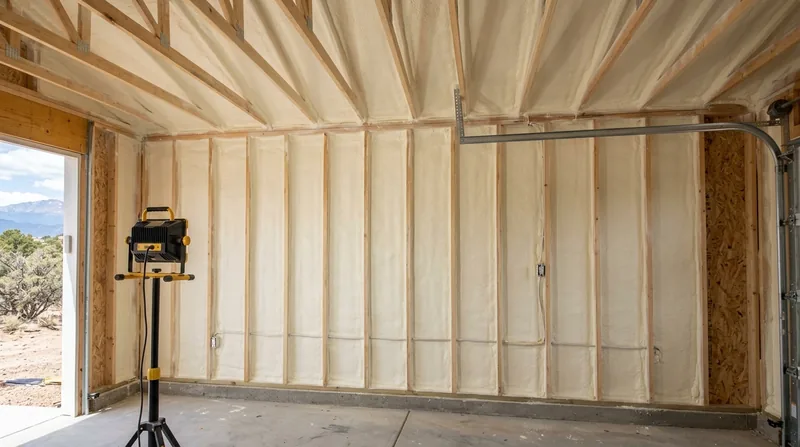




Garages across Colorado Springs and out toward Black Forest take the same wind-driven heat loss as the house itself, and a cold snap in January will pull heat straight through an uninsulated ceiling and rim joist faster than most homeowners expect. Garage spray foam insulation seals that envelope tight, keeping shops and garages warmer through winter and cooler in summer while cutting the strain on any heating or cooling equipment nearby. At elevation and in the shadow of Pikes Peak, where wind gusts routinely exceed 30 miles per hour and winter temperatures drop into the teens, an insulated garage becomes a real asset, not just a storage shed. Whether you work out there, park equipment, or simply want to stop losing conditioned air to the space above, foam insulation and air sealing deliver the control you need. We help homeowners and contractors across El Paso and Teller counties turn garages into usable, climate-controlled spaces.
Why Garage Insulation Matters in Colorado Springs' High-Wind, High-Altitude Climate
Colorado Springs sits at 6,100 feet with consistent wind pressure and temperature swings that stress any uninsulated structure. A detached garage or shop loses heat through the ceiling, walls, and rim joist at a rate that surprises most owners when they see the utility bill or try to work in the space on a winter morning. Spray foam stops that leakage by sealing every cavity, every penetration, and every thermal bridge in one pass, creating a continuous air barrier that fiberglass or cellulose cannot match. The dry Colorado air means moisture drive is rarely the issue here, but air infiltration and radiant heat loss are constant, day and night.
- Stop heat loss through uninsulated rim joists and band joists that run the perimeter of the garage foundation.
- Seal the garage ceiling to prevent warm air from rising into an unconditioned attic or roof cavity.
- Block wind-driven air leakage through wall cavities, door frames, and utility penetrations that fiberglass misses.
- Reduce the load on any heating unit if the garage is semi-conditioned or ducted from the main house.
- Create a stable interior temperature for tool storage, vehicle protection, or a working shop space year-round.
These improvements work because foam insulation is both insulation and air sealing at the same time, addressing the two failure modes that dominate garage comfort in this climate.
Key info: A typical two-car garage in Briargate or near the Broadmoor loses 20 to 40 percent of its heat through an uninsulated ceiling and rim joist during a cold snap. Foam insulation with proper air sealing cuts that loss by 70 to 90 percent, depending on existing conditions and the R-value installed.
See how rim joist and band joist spray foam insulation works as a critical piece of the garage envelope.
How We Insulate and Seal Garages Across Colorado Springs
Our process starts with a walk-through to identify all the air leaks and thermal weak spots: the garage ceiling, the rim joist where the foundation meets the walls, any wall cavities that are exposed or accessible, and penetrations for electrical, plumbing, or HVAC lines. We then choose between closed cell and open cell foam based on the space, the use case, and whether moisture or condensation control is a factor. For most garages in Colorado Springs, closed cell foam on the ceiling and rim joist is the standard because it delivers higher R-value in a thinner depth and handles the occasional temperature swing without risk. Once foam is applied, we let it cure fully before the space is re-entered, typically 24 to 48 hours depending on temperature and humidity.
- We conduct a free on-site estimate to assess the garage ceiling height, rim joist accessibility, and any existing insulation or obstructions.
- We specify the foam type, R-value, and thickness in writing before any work begins, so you know exactly what you are paying for.
- We apply foam in controlled passes, maintaining proper drum temperature and mix ratio to ensure full expansion and no voids.
- We provide mechanical ventilation during the cure period to manage off-gassing and ensure safe re-entry within the stated window.
- We seal all exposed edges and verify air sealing around penetrations before we leave the site.
This methodical approach is what separates a lasting installation from a quick spray-and-go job that leaves odor, settling, or gaps.
Example: A detached garage in Security-Widefield with a vaulted ceiling and an exposed rim joist typically takes one day to foam the ceiling (3 to 4 inches of closed cell, R-18 to R-24) and air seal the rim joist. A single-car garage in Monument or Manitou Springs may take half a day. A larger workshop or metal building garage requires a separate estimate.
Learn more about closed cell spray foam insulation and its performance in Colorado's climate.
Garage Insulation Methods: Closed Cell vs. Open Cell vs. Existing Removal
| Approach | Description | Best for |
|---|---|---|
| Closed Cell Foam | High-density foam (1.5 to 2.0 lb/cu ft) with tight cell structure, R-value 6.0 to 7.0 per inch, acts as both insulation and air barrier, vapor-tight, minimal settling. | Garage ceilings and rim joists in Colorado Springs, especially where space is tight or condensation control matters; standard choice for most detached garages. |
| Open Cell Foam | Low-density foam (0.5 to 1.0 lb/cu ft) with open cell structure, R-value 3.5 to 3.7 per inch, vapor-permeable, softer, good sound dampening, lower cost per board foot. | Garage walls or ceilings where budget is the priority and the space is not at risk of condensation; sound-dampening in workshop environments. |
| Insulation Removal + Foam | Remove failed fiberglass, settling cellulose, or old foam before spraying new closed or open cell; ensures clean substrate and full contact with the structure. | Garages with existing insulation that has settled, moisture damage, or gaps; retrofit jobs where a fresh start is needed. |
| Air Sealing Only | Spray foam around rim joists, band joists, and penetrations without full ceiling coverage; targeted approach to the biggest heat loss points. | Garages with sound attic or ceiling insulation already in place; focus on stopping air leakage at the foundation and rim. |
Each method has a place, and the right choice depends on the current condition of the garage, the climate control you want, and your budget. We help you understand the trade-off between R-value, thickness, cost, and long-term performance during the estimate.
Garage Spray Foam Insulation Cost in Colorado Springs: What to Expect
Garage spray foam insulation in Colorado Springs typically starts at $1,200 for a single-car garage with a simple ceiling and rim joist foam application. A two-car garage with full ceiling coverage and complete rim joist sealing usually runs $2,000 to $3,500, depending on the depth of foam, the R-value specified, and whether any existing insulation needs removal first. Larger detached shops, metal buildings, or garages with complex geometry or difficult access can exceed that range and require a site estimate to price accurately.
The main factors that move the cost are the square footage of the ceiling, the linear feet of rim joist to seal, the foam type (closed cell costs more per board foot than open cell), the R-value target, and whether the substrate is clean or requires removal and prep work first. If your garage has old fiberglass insulation, we remove it first, which adds to the scope but ensures the foam bonds properly and you get the full air-sealing benefit. Travel across Colorado Springs and surrounding areas is included in our estimate; there is no separate mileage fee.
The best way to know what your garage will cost is to request a free estimate. We respond within 24 hours and provide a written quote with R-value, thickness, and board-foot totals so you can compare apples to apples. See our full pricing overview for a breakdown of typical jobs and what drives the cost up or down.
What to Look for When Hiring a Spray Foam Insulation Contractor Near Me in Colorado Springs
Not all spray foam installers are equal, and the difference between a professional installation and a rushed job shows up in odor, settling, gaps, and performance. When you are comparing contractors for your garage, look for a few concrete markers: a written estimate that names the foam type, R-value, and thickness in board feet; a crew that brings mechanical ventilation equipment and plans for a 24 to 48-hour cure window; insurance that you can verify; and a willingness to answer questions about mix ratio, drum temperature, and application technique. Avoid any quote that is dramatically below market, any promise of immediate re-entry, or any contractor who cannot or will not provide references from recent jobs in Colorado Springs or the surrounding area.
- Ask for a written estimate with R-value, thickness, and board-foot totals, not just a price per square foot.
- Verify that the contractor carries full insurance and can provide a certificate of insurance before work starts.
- Request references from at least two or three recent garage or residential spray foam jobs in Colorado Springs or nearby.
- Confirm that the crew will provide mechanical ventilation during cure and will not allow re-entry until the full cure window has passed.
- Check the Colorado Springs building code and your local city or county requirements for any permits or inspections that may apply to the work.
- If your garage is in a master-planned community or HOA, verify that exterior work or roof access does not trigger architectural review.
Taking time to vet a contractor before you sign is the single best way to avoid a bad installation and the cost of fixing it later. Contact us with your questions or to schedule your free estimate, and we will walk you through the process and answer anything you want to know.
Garage Spray Foam Insulation in Colorado Springs: Pricing Guide
| Service | Price | Details |
|---|---|---|
| Single-car garage ceiling and rim joist | Starting at $1,200 | Closed cell foam, 3 to 4 inches, R-18 to R-24, includes air sealing around rim and penetrations |
| Two-car garage, full ceiling and rim coverage | Starting at $2,000 | Closed cell foam on ceiling and rim joist, removal of existing insulation if needed, complete air sealing |
| Detached shop or metal building garage | Starting at $2,500 | Larger square footage and complex geometry; price depends on wall coverage, condensation control needs, and access difficulty |
| Insulation removal and replacement | On estimate | Removal of failed or settled insulation adds time and disposal cost; quoted separately based on volume and condition |
| Free estimate | No obligation | Response within 24 hours, written quote with R-value and thickness, (719) 722-2568 |
Indicative pricing, the exact cost depends on square footage, finish, and site access. Free personalized estimate within 24h at (719) 722-2568.


