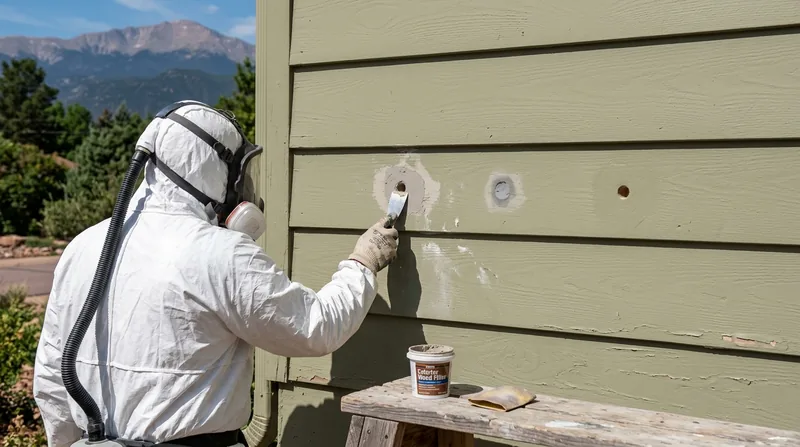




Colorado Springs sits at the foot of Pikes Peak in IECC climate zone 5B, where winter heating dominates energy bills and wind-driven infiltration compounds the problem. Homes built in the mid-20th century across Old Colorado City, the Broadmoor area, and established neighborhoods throughout El Paso County were framed with wall cavities that were never sealed to modern standards. Wall and injection foam insulation fills those closed cavities without opening drywall, stopping drafts that have leaked conditioned air for decades. A small hole drilled, filled with foam, and patched is all it takes to reclaim comfort and reduce the constant wintertime heat loss that defines this climate. Read on to understand how injection foam works, what it costs, and how to hire the right contractor for your Colorado Springs home.
Why Wall and Injection Foam Insulation Matters in Colorado Springs Homes
The Colorado Springs building stock tells a clear story. Homes built before 1980 have wall cavities that were framed but never insulated, or insulated with fiberglass that has settled, compressed, or never filled the space properly. The Front Range wind, combined with winter temperatures that drop well below freezing, drives heat loss through every unsealed cavity in the rim joist, the top plates, and the exterior walls themselves. Energy bills track the heating season first, and every degree of temperature difference between inside and outside pushes more money out through gaps in the wall assembly. Injection foam reaches into cavities that would otherwise require demolition to access, making it the only practical retrofit for homes where the drywall is finished and the walls are occupied.
- Stops air infiltration through closed wall cavities without any drywall removal or interior demolition.
- Fills voids completely, eliminating the settling and compression problems that plague fiberglass batts.
- Works on any exterior wall, including rim joists, band joists, and the top plates above basements where heat loss is fastest.
- Reduces winter heating load and cuts the drafts that make rooms feel cold even when the thermostat says it is warm.
- Improves sound dampening and creates a thermal break that reduces exterior noise from wind and traffic.
Injection foam is the retrofit answer for the Colorado Springs home where tearing down walls is not an option and energy bills have been climbing for years.
Key info: Colorado Springs and surrounding areas experience winter heating as the primary energy load and constant wind infiltration that accelerates heat loss. Mid-century homes from Security-Widefield to Monument to the Broadmoor area carry unsealed wall cavities that are the single biggest source of wintertime comfort loss. Injection foam reaches those cavities without renovation.
For more context on how air sealing integrates into a complete insulation strategy, see our air sealing service page.
How Injection Foam Insulation Works: The Colorado Springs Process
Injection foam is a low-pressure process that fills existing wall cavities from the outside without disturbing the interior. A technician drills small access holes (typically 1.5 inches) through the rim band, the exterior wall sheathing, or the band joist, injects two-part foam that expands to fill the entire cavity, and patches the hole with a wooden dowel and caulk. The foam cures in place, hardening into a solid block that stops air movement, fills voids, and creates continuous insulation from rim to top plate. In Colorado Springs homes, this process typically takes one to three hours per wall section, depending on the cavity depth and the number of holes required to reach all corners.
- We identify the wall cavity dimensions and depth using a moisture meter and visual inspection from the exterior.
- We drill small access holes spaced 16 to 24 inches apart to ensure complete cavity fill without over-pressurization.
- We inject two-part closed-cell or open-cell foam that expands to fill the entire void and bonds to the rim band, rim joist, and band joist framing.
- We allow the foam to cure per manufacturer specifications (typically four to six hours) before patching the holes with wooden dowels and exterior caulk.
- We finish the exterior with caulk that matches your rim band or band joist color and seals the repair permanently.
The result is a sealed wall cavity that stops the draft you can feel in winter and cuts the heating load that drives your energy bill higher every season.
Local example: A 1960s home in Old Colorado City with a 30-foot rim joist above an unheated basement, never insulated, typically requires 15 to 20 injection points and takes 2 to 3 hours. The homeowner sees the drafts disappear immediately and the heating bill drop by 10 to 20 percent in the first winter. A similar home in the Broadmoor area with a finished basement and an accessible rim joist follows the same process.
To understand how injection foam fits into a broader insulation retrofit strategy, see our insulation replacement and re-insulation service.
Injection Foam Methods and Applications
| Approach | Description | Best For |
|---|---|---|
| Closed-Cell Injection Foam | High-density foam with an R-value of 6.0 to 6.5 per inch, low permeability, and maximum structural rigidity. Requires precise drum temperature and equipment calibration. | Rim joists, band joists, and exterior walls in Colorado Springs where maximum R-value and air sealing are the priority. |
| Open-Cell Injection Foam | Lower-density foam with an R-value of 3.5 to 3.7 per inch, higher vapor permeability, and lower cost. Expands more aggressively and fills irregular cavities more readily. | Interior wall cavities in conditioned space where cost is a factor and vapor drive is not a concern in Colorado's dry climate. |
| Rim Joist and Band Joist Injection | Closed-cell foam injected into the rim band cavity above the foundation wall, the single biggest heat loss point in Colorado Springs basements. | Any Colorado Springs home with a basement, especially mid-century construction where the rim joist was framed but never insulated. |
| Top Plate and Exterior Wall Injection | Foam injected into the top plate cavity and the exterior wall cavities where they meet the attic, stopping the stack effect and the constant upward draft in winter. | Homes across Colorado Springs where attic heat loss and wintertime drafts are compounded by an unsealed top plate. |
Wall and Injection Foam Insulation Cost in Colorado Springs: What to Expect
Injection foam insulation in Colorado Springs typically starts at $2 to $4 per square foot of wall cavity treated, depending on the depth of the cavity, the number of holes required, and the foam type selected. A typical rim joist retrofit on a Colorado Springs home with 30 to 40 linear feet of exposed rim band costs $600 to $1,200 for closed-cell foam, or $400 to $800 for open-cell foam. Larger jobs, such as injecting multiple exterior walls or the top plate cavity in addition to the rim joist, scale upward proportionally. The cost per square foot reflects the labor of drilling, injecting, curing, and patching, plus the material cost of the foam system itself.
Several factors move the cost up or down within that range. Cavity depth matters: a 12-inch rim joist cavity requires fewer passes and less material than a 16-inch cavity. Access also matters: a rim joist that is easily reached from the outside costs less than one that requires scaffolding or interior work to reach. The number of holes and the spacing between them depend on the cavity width and the foam type: open-cell expands more aggressively and may need fewer holes, while closed-cell requires more precise spacing to avoid over-pressurization. Finally, the choice between closed-cell and open-cell foam adds $1 to $2 per square foot for the closed-cell premium, which is justified by the higher R-value and the superior air sealing in Colorado Springs' windy climate.
Getting two or three estimates before committing is the smart move. Each estimate should include the cavity dimensions, the foam type, the R-value and thickness per pass, the number of injection points, the curing time, and the final patching method. A written estimate with these details tells you that the contractor understands the job and is ready to execute it correctly. For a detailed pricing overview and to request a free estimate tailored to your Colorado Springs address, visit our pricing page or call (719) 722-2568.
What to Look for When Hiring a Spray Foam Insulation Contractor Near Colorado Springs
Hiring the right contractor for wall and injection foam insulation in Colorado Springs means checking three things: insurance, estimates, and references. First, verify that any contractor you interview carries full general liability and workers compensation insurance. Ask for a certificate of insurance and confirm that it covers spray foam and injection work. Second, get written estimates from at least two contractors, and compare them side by side. A low estimate with no R-value, no thickness spec, no mention of curing time, and no detail on how the holes will be patched is a red flag. A realistic estimate will name the foam type, state the R-value per inch, specify the number of passes and the thickness per pass, and describe exactly how the access holes will be closed. Third, ask for references from Colorado Springs homeowners who had injection foam work done in the last two years, and call at least one. Ask whether the work was clean, whether the smell was manageable, whether the patching was invisible, and whether the drafts really stopped.
- Request a written estimate that names the foam system, specifies R-value per inch, and states the number and spacing of injection holes.
- Verify full general liability and workers compensation insurance with a certificate of insurance before any work begins.
- Ask for references from Colorado Springs homeowners and call at least one to confirm the quality of the patching and the effectiveness of the seal.
- Confirm that the contractor has a local address and local phone number, and that someone will be reachable if questions arise after the job is done.
- Understand the re-entry window (typically 24 to 48 hours) and the curing time before the patched areas can be painted or sealed.
A contractor who answers your questions clearly, provides a detailed written estimate, and carries verifiable insurance is the one who will do the job right. For a free estimate from a Colorado Springs contractor with 13 years in the trade, contact us today or call (719) 722-2568.
Wall & Injection Foam Insulation in Colorado Springs: Pricing Guide
| Service | Price | Details |
|---|---|---|
| Rim Joist and Band Joist Injection | Starting at $600 | Closed-cell foam for 30 to 40 linear feet of rim band, the most common retrofit in Colorado Springs basements |
| Exterior Wall Cavity Injection | Starting at $2 per sq ft | Closed-cell foam for wall cavities, cost scales with cavity depth and the number of injection holes required |
| Top Plate and Multi-Wall Retrofit | On estimate | Injecting rim joist plus exterior walls plus top plate requires an on-site inspection to measure cavity dimensions and access |
| Open-Cell Injection Alternative | Starting at $1.25 per sq ft | Lower R-value but lower cost, best for interior walls where maximum insulation value is not the primary goal |
| Free Written Estimate | No charge | Response within 24 hours at (719) 722-2568, includes cavity dimensions, foam type, R-value, and final patching method |
Indicative pricing, the exact cost depends on square footage, finish, and site access. Free personalized estimate within 24h at (719) 722-2568.


