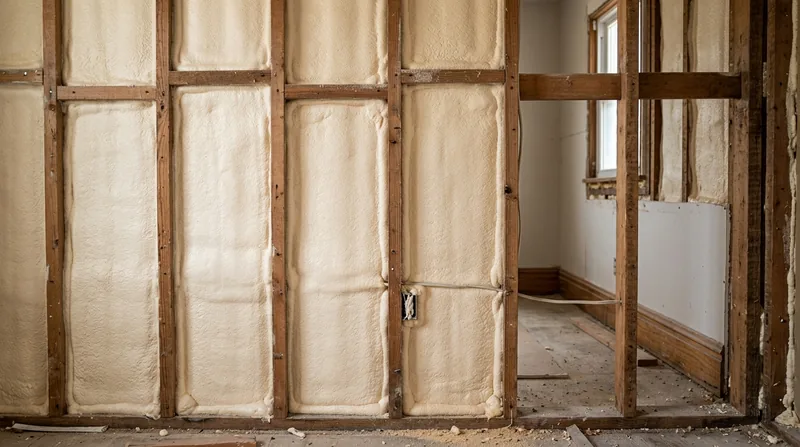




Open cell spray foam insulation in Colorado Springs fills wall cavities, seals air leaks, and dampens the constant whistle of Front Range wind that drives heat loss through older homes in Old Colorado City and newer builds across Briargate. At the foot of Pikes Peak, where winters drop below zero and summer sun bakes vented attics past 140 degrees, air sealing is the first line of defense against energy bills that track the heating season first and wind infiltration second. Open cell spray foam insulation expands to fill every void in wall assemblies, basement rim joists, and garage ceilings, stopping the convective loop that pulls warm air out of your home and cold air in. Unlike closed cell foam, open cell is softer, less dense, and significantly cheaper per board foot, making it the right choice for sound control and interior wall retrofit where moisture drive is not the limiting factor. We help Colorado Springs homeowners and builders navigate the choice between open and closed cell foam, and sometimes recommend blown-in fiberglass when a sound attic just needs a top-up. Since 2010, we have installed open cell foam in homes from downtown Colorado Springs to Monument, Fountain, and the acreage properties of Black Forest and Elbert County.
Why Open Cell Spray Foam Insulation Matters in Colorado Springs
Colorado Springs sits in IECC climate zone 5B with a heating season that lasts seven months and heating degree days that demand continuous air sealing. Older homes in the neighborhoods near downtown and the Broadmoor show flattened attic insulation and drafty rim joists above basements, while mid-century stock across town carries original wall cavities never designed for today's thermal load. Newer subdivisions in Briargate and the growth corridor toward Monument are built on basement foundations with vented attics, long runs of top plates, and countless penetrations where conditioned air leaks out. Wind infiltration is the dominant failure mode here, not moisture drive. Open cell foam seals these paths and cuts the draft whistle that Colorado homeowners hear every winter.
- Expands to fill wall cavities in older homes without demolition, stopping air leakage through rim joists and basement band boards.
- Dampens sound transmission and reduces the high-frequency whistle of wind through wall assemblies on exposed lots.
- Costs significantly less per board foot than closed cell foam, making wall and attic retrofit affordable on a modest budget.
- Cures to a soft, semi-permeable state that allows wall cavities to dry if moisture enters, a key advantage in retrofit work.
- Meets Colorado building code thermal barrier and ignition barrier requirements when applied at the correct thickness and with the right facing material.
Open cell foam solves the air sealing problem that fiberglass alone cannot address, and it does so at a price point that makes the job feasible for homeowners across El Paso and Teller counties.
Key info: Colorado Springs sits at 6,035 feet elevation where outside air is cold and dry most of the year. Humidity stays below 40 percent from October through April, so the real enemy is air leakage and heat loss, not moisture drive. Open cell foam's permeability is an asset here, not a liability. The 15-minute thermal barrier distinction is governed by the building code in force at your address and by the building official in your city, not by us. Always verify what applies to your specific job with your local building department.
How We Install Open Cell Spray Foam Insulation in Colorado Springs
Open cell foam installation starts with a site assessment, measurement of wall cavities and attic spaces, and a written estimate that specifies R-value and thickness in board feet. We control the spray ratio, drum temperature, and application rate to ensure the foam expands correctly and cures to the right density. Mechanical ventilation runs during cure and for the full re-entry window, which we state as 24 to 48 hours before the space is occupied. Our crew removes old insulation if it is failed, contaminated, or blocking access, and we seal the substrate before foam goes down. We do not spray over wet, leaking, or compromised surfaces. If moisture is present, we fix it first or we walk away.
- We visit your home or building, measure cavities and existing insulation, and assess access and substrate condition.
- We provide a written estimate with R-value per inch, total board feet, and thickness specifications in inches.
- We remove any existing insulation that is failed, flattened, or blocking the cavity, and we haul it away.
- We seal air leaks, electrical penetrations, and rim joists with caulk or foam before the main spray application begins.
- We apply open cell foam at the manufacturer's specified ratio and drum temperature, controlling thickness and density.
- We run mechanical ventilation during the entire cure window and state a re-entry time of 24 to 48 hours before occupancy.
The result is a sealed, insulated assembly that stops air infiltration and reduces heating and cooling load on your HVAC system. For more on how we handle larger attic jobs, see our attic spray foam insulation service page.
Example: A 1970s ranch in Security-Widefield with original fiberglass in the walls and a leaky rim joist above the basement. We remove the old batts, seal the rim board and band joist with closed cell foam, then inject open cell foam into the wall cavities from the inside without tearing out drywall. The homeowner avoids demolition and gets a sealed, insulated wall assembly for a fraction of the cost of new construction.
Open Cell Spray Foam Insulation Methods and Applications
| Approach | Description | Best for |
|---|---|---|
| Interior wall cavity spray | Open cell foam injected into wall cavities from inside without demolition, using access holes through drywall. | Retrofit of older Colorado Springs homes where new framing is not an option and air sealing is the priority. |
| Attic floor and rim joist sealing | Open cell foam applied to attic floor edges, rim boards, and band joists to seal the air barrier above basement walls. | Mid-century homes across Briargate and downtown Colorado Springs with vented attics and drafty basement rim joists. |
| New construction wall framing | Open cell foam sprayed into wall cavities during framing stage before drywall installation, ensuring complete fill and no voids. | New builds in Monument, Fountain, and Briargate where the framing is open and the builder wants speed and air sealing combined. |
| Garage ceiling and workshop insulation | Open cell foam applied to underside of garage roof decks and detached shop ceilings to reduce heat loss and sound. | Detached garages and shops on acreage properties in Black Forest, Elbert, and Fremont counties exposed to constant wind. |
| Sound-dampening interior applications | Open cell foam sprayed into wall cavities and ceiling cavities to absorb sound and reduce transmission between rooms. | Home offices, basements, and interior walls in Colorado Springs where noise reduction is as important as thermal performance. |
Open Cell Spray Foam Insulation Cost in Colorado Springs: What to Expect
Open cell spray foam in Colorado Springs typically starts at $0.55 per board foot and can range up to $0.75 per board foot depending on wall cavity size, access difficulty, substrate condition, and whether existing insulation must be removed. A typical wall retrofit in a 1970s ranch might cost between $1,200 and $2,800 depending on the linear feet of rim joist, the number of wall cavities, and the labor required to seal and prepare the assembly. Attic floor sealing on a 1,500-square-foot home typically runs $800 to $1,600. A garage ceiling on a detached structure might be $400 to $900. These are ballpark figures and will move based on your specific layout, access, and existing conditions.
Factors that affect the cost include the number of cavities to fill, the thickness required to meet code and R-value targets, whether old insulation must be hauled away, how accessible the work is, and whether the substrate is clean and dry. A home with rim joist insulation, wall cavity retrofit, and attic floor sealing in one project will often qualify for a package price that is lower per board foot than the same work done separately. Always get 2 or 3 written estimates that include R-value and thickness specifications so you can compare apples to apples. For detailed pricing on all our services, visit our pricing page.
We provide free estimates within 24 hours and with no obligation to book. Call us at (719) 722-2568 or contact us online, and we will schedule a time to walk your home and give you a number you can rely on.
What to Look for When Hiring an Open Cell Spray Foam Contractor Near Colorado Springs
Hiring the right spray foam contractor is the difference between a job that solves your air leakage problem and one that leaves you with odor, poor coverage, or liability issues down the road. Colorado Springs has both local independent shops and national franchise crews, and the choice matters. A reputable contractor will provide a written estimate with R-value and thickness specifications, explain the cure time and re-entry window upfront, and carry insurance that can be verified. Ask for references from recent jobs in Colorado Springs or nearby areas, and call them to ask about the quality of work and how the crew handled the job site. Verify that the contractor has experience with your specific application, whether that is wall cavity retrofit, rim joist sealing, or attic floor work.
Avoid any contractor who quotes a price without measuring the space, who promises immediate re-entry, who cannot provide a written estimate with R-value and thickness, or whose insurance cannot be verified by name and policy number. If your home is in an HOA, check the architectural guidelines before scheduling work, as some master-planned communities require approval for exterior foam application on metal buildings or garages. Permitting requirements vary by city across Greater Colorado Springs, so ask your contractor how they will navigate the local building department and what thermal barrier or ignition barrier requirements apply to your address. The best contractor will defer to the local building official and will not promise to spray over wet, contaminated, or leaking substrates.
Ready to get started? Contact us for a free estimate, and we will walk you through the process and answer any questions about open cell spray foam for your Colorado Springs home or building.
Open Cell Spray Foam Insulation in Colorado Springs: Pricing Guide
| Service | Price | Details |
|---|---|---|
| Open cell spray foam insulation | Starting at $0.55/board ft | Wall cavities, rim joists, and attic floor sealing. Price varies by cavity size, access, and substrate condition. |
| Rim joist and band board sealing | Starting at $400-$900 | Sealed and insulated basement rim joists reduce heat loss through the foundation band. Includes substrate prep and foam application. |
| Wall cavity retrofit (interior injection) | Starting at $1,200-$2,800 | Retrofit of existing walls without demolition. Cost depends on linear feet, cavity depth, and whether old insulation must be removed. |
| Insulation removal and haul-away | Included in estimate | Failed or flattened insulation is removed and disposed of before foam is applied. Cost is factored into the overall project price. |
| Free written estimate | No charge | Response within 24 hours at (719) 722-2568. Estimate includes R-value, thickness in inches, and total board feet. |
Indicative pricing, the exact cost depends on square footage, finish, and site access. Free personalized estimate within 24h at (719) 722-2568.


