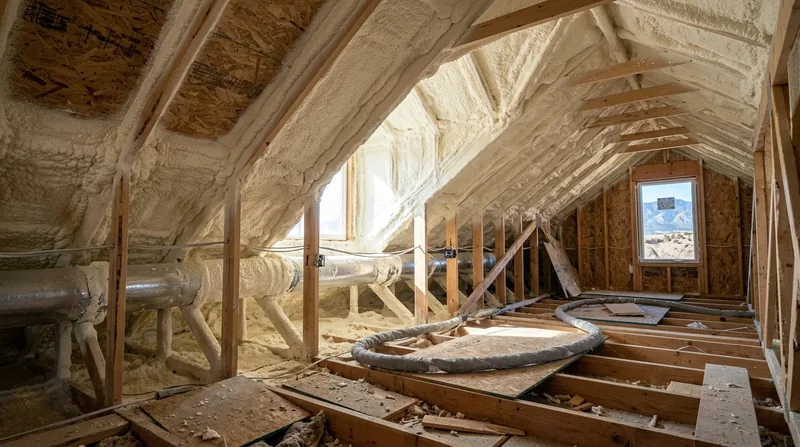




Colorado Springs sits at the foot of Pikes Peak in IECC climate zone 5B, where winter cold snaps drop temperatures fast and strong Front Range sun bakes attics hard in summer. Most homes across the city and surrounding El Paso County rest on basement foundations with vented attics that leak conditioned air year-round, whether through rim joists, top plates, or the attic deck itself. The result is uneven indoor temperatures, ice dams in winter, and energy bills that track the heating season first. Attic spray foam insulation in Colorado Springs stops that air leakage at the source by sealing the deck and the rim, creating a conditioned attic space that holds temperature steady and cuts the load on your furnace and air conditioner. We spray foam the attic to fit your home's actual climate and your heating and cooling needs, not the generic fiberglass that settles and leaves gaps. The work is measured, inspected, and built to code, with a clear written estimate that names the R-value and thickness before we start.
Why Attic Spray Foam Insulation Matters in Colorado Springs Homes
Older homes in Old Colorado City and near downtown often carry original wall cavities and attics that were never designed for today's heating and cooling loads. Mid-century houses around the Broadmoor and across town show flattened fiberglass insulation and drafty rim joists that bleed heat during winter. Newer subdivisions in Briargate and the growth corridor toward Monument and Fountain are built on basement foundations too, with vented attics, long runs of top plates, and dozens of penetrations where conditioned air escapes. The real enemy in Colorado Springs is air leakage and heat loss in winter, not moisture drive, because humidity stays low most of the year. Spray foam seals the attic deck and stops that leakage cold.
- Spray foam stops air leakage through the attic deck, rim joists, and top plates where fiberglass leaves gaps.
- A sealed attic deck reduces the heating load on your furnace during winter cold snaps and cuts summer cooling demand when the sun bakes the roof.
- Spray foam holds its R-value over time and does not settle or compress like blown-in fiberglass.
- Sealing the attic deck with spray foam also quiets wind noise and reduces dust infiltration into the living space.
Colorado Springs building code and energy code requirements for attic ventilation, ignition barriers, and thermal barriers are set by the building official at your address, not by us. Always check with your local building department to confirm what applies to your home and permit status.
Key info: A home in Monument or Woodland Park loses heat faster through an uninsulated rim joist and vented attic than through the walls. Sealing those two zones with spray foam is the highest-return upgrade in zone 5B.
For details on Colorado Springs building permits and energy code, visit the City of Colorado Springs Building and Safety Division or contact your local building department.
How We Spray Foam Your Attic in Colorado Springs
We start with a site visit to measure the attic, identify air leaks, check for existing insulation and moisture, and confirm what your home needs. We write a detailed estimate that specifies the R-value, foam thickness per pass, and total coverage area so you know exactly what you are getting. Once you approve, we prepare the attic, set up mechanical ventilation for the cure period, spray the foam in controlled passes to achieve the target thickness, and allow the full re-entry window of twenty-four to forty-eight hours before you use the space. The foam cures to full strength in that window and off-gases completely. We clean up after ourselves and leave you with documentation of what was installed and where.
- We inspect the attic for moisture, active leaks, or contamination and address those before we spray.
- We seal rim joists, top plates, and penetrations with spray foam to stop air leakage at the thermal boundary.
- We spray the attic deck with closed cell or open cell foam depending on your climate and your budget.
- We run mechanical ventilation during cure and post a re-entry window so your home is safe to occupy on schedule.
- We provide a written record of the R-value, thickness, and coverage so you have proof of the work for your records and any future sale.
The entire process takes one to two days depending on attic size and complexity. For more on our approach to air sealing and attic work, see our air sealing service page.
Example: A 1,200-square-foot attic in Security-Widefield with a vented deck and existing fiberglass takes about one and a half days. We remove the old insulation, seal the rim and top plates, spray four inches of closed cell foam on the deck for R-24, and cure over two days. The homeowner re-enters on day three.
If your attic has existing insulation that needs removal first, see our insulation removal service for details on safe and complete tear-out.
| Approach | Description | Best for |
|---|---|---|
| Closed cell spray foam | Dense, rigid foam with an R-value of 6 to 7 per inch. Provides air seal and moisture barrier. Requires mechanical ventilation during cure. | Attics in cold climates where condensation risk is real and you need maximum R-value in minimal thickness. Sealed roof decks. |
| Open cell spray foam | Lighter foam with an R-value of 3.5 to 4 per inch. Breathable and flexible. Better sound dampening. Lower cost per board foot. | Attics where you want good air sealing, lower cost, and the attic can still breathe. Vented attics and supplemental insulation. |
| Rim and band joist foam | Targeted closed cell spray foam at the rim joist and band joist above the basement. Stops the fastest heat loss path in a basement home. | Any Colorado Springs home on a basement foundation where the rim bleeds heat in winter and cooling escapes in summer. |
| Attic deck plus rim and joist combo | Full thermal boundary sealing: spray foam on the attic deck and sealed rim joist to create a complete air and thermal barrier. | Homes where you want the highest energy efficiency and the most stable indoor temperature in all seasons. |
Attic Spray Foam Insulation Cost in Colorado Springs: What to Expect
Attic spray foam insulation in Colorado Springs starts at $1.50 per square foot for basic open cell coverage on a straightforward deck with good access. The price moves up based on attic size, whether existing insulation needs removal, the foam type you choose, and the complexity of the rim and penetration sealing. A typical attic of 1,200 to 1,500 square feet in a home near downtown or in Briargate runs between $2,000 and $4,500 depending on whether you seal the rim joist and attic deck together or just the deck. Larger homes in Woodland Park or Monument with more complex attics may run higher. Always get two or three written estimates that specify the R-value, thickness per pass, and total square footage so you can compare apples to apples.
The cost also depends on whether the attic has existing insulation that must be removed first. If you need insulation removal, that is a separate line item and must be done before spray foam goes in. A home with old blown-in fiberglass or cellulose will need tear-out before the foam is applied. If you are topping up a sound attic with existing insulation, blown-in fiberglass is sometimes the right answer and costs less than spray foam. We tell you honestly which option makes sense for your home.
For a detailed breakdown of pricing by service type and to request a free written estimate, visit our pricing page or call (719) 722-2568.
What to Look for When Hiring a Spray Foam Insulation Contractor Near Colorado Springs
Spray foam insulation work is not licensed as a separate trade in Colorado, but any contractor working in your city must be registered with the city or county and carry full insurance. Ask any contractor you consider, including us, to provide proof of current insurance coverage before work starts. Get a written estimate that names the R-value, foam thickness, and total coverage area so you know what you are paying for. Avoid any estimate with no R-value, no thickness specification, or a price far below market with no inspection. Ask whether the contractor will run mechanical ventilation during the cure period and what re-entry window they post. Reputable installers control the foam temperature, maintain the correct drum ratio, spray in controlled passes, and allow a full twenty-four to forty-eight hour cure before you re-enter.
- Verify that the contractor is fully insured and can provide a current certificate of insurance.
- Get a written estimate with the R-value, thickness per pass, and total square footage specified in advance.
- Ask whether the contractor will inspect the attic for moisture or contamination and address those before spraying.
- Confirm that mechanical ventilation will run during the cure and that the contractor posts a clear re-entry window.
- Check references from recent jobs in Colorado Springs and ask about the contractor's response time if issues come up after the work.
If your home is in a HOA community or a heritage district, check whether architectural approval is required for any exterior work. For attic work inside the home, exterior rules rarely apply, but it is worth confirming with your HOA before you book. For guidance on hiring and questions about our own credentials and insurance, contact us at our contact page or call (719) 722-2568 for a free estimate.
Attic Spray Foam Insulation in Colorado Springs: Pricing Guide
| Service | Price | Details |
|---|---|---|
| Attic deck spray foam, open cell | Starting at $1.50/sq ft | Three to four inches of open cell foam on an accessible attic deck with good ventilation during cure and no removal needed |
| Attic deck spray foam, closed cell | Starting at $2.25/sq ft | Four to five inches of closed cell foam for sealed attics, condensation control, and maximum R-value in minimal depth |
| Rim joist and band joist foam | Starting at $8.00/linear foot | Closed cell foam applied to rim and band joists above basement foundation, the fastest heat loss path in zone 5B homes |
| Attic deck plus rim joist combo | Starting at $2,500 for typical home | Full thermal boundary sealing on a 1,200 to 1,500 square foot attic with rim and top plate foam included in one job |
| Insulation removal before spray foam | On estimate | Tear-out and disposal of existing fiberglass, cellulose, or other insulation required before spray foam application |
| Free written estimate | No obligation | Response within 24 hours at (719) 722-2568, includes R-value, thickness, and square footage with no pressure to book |
Indicative pricing, the exact cost depends on square footage, finish, and site access. Free personalized estimate within 24h at (719) 722-2568.


