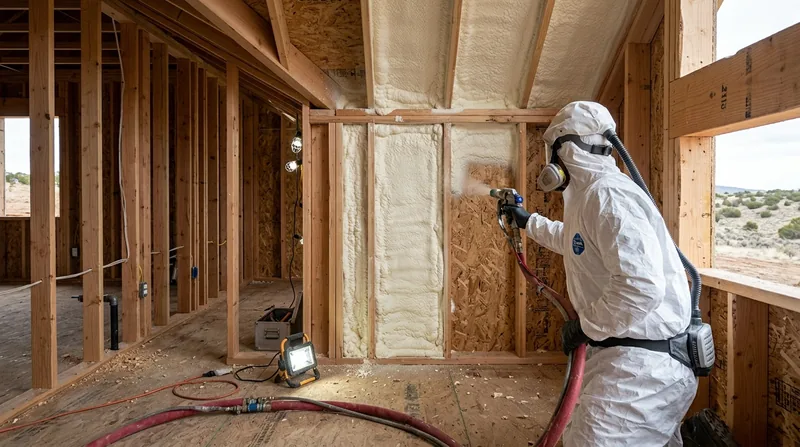




Commercial and new construction spray foam insulation in Colorado Springs requires a different approach than residential retrofits. Builders across El Paso and Douglas counties work on tight schedules, and foam must be sized for the wind load, solar gain, and thermal cycling that define the Front Range climate. Whether you are framing a new shell in Briargate, building out a spec house in Monument, or converting an agricultural property into a barndominium near Black Forest, the insulation envelope has to perform from day one. We work with general contractors, builders, and property owners to foam walls, attics, crawl spaces, and rim joists before drywall, flooring, or mechanical systems go in. Getting the foam right at the framing stage costs less, performs better, and eliminates the rework that always costs more later.
Why Commercial and New Construction Spray Foam Matters in Colorado Springs
Colorado Springs sits at 6,100 feet elevation in IECC climate zone 5B, where winter heating loads are steep and wind-driven heat loss is constant. New construction in subdivisions like Briargate and along the Monument corridor is built on basement foundations with standard framing, vented attics, and long runs of top plates and rim joists where conditioned air escapes fastest. Metal buildings, pole barns, and barndominium conversions on acreage in Black Forest and Elbert County face even harsher exposure: no shelter from wind, intense solar gain on unshaded metal roofs in summer, and condensation risk on uninsulated steel in winter. Foam applied at the time of construction seals the envelope before drywall covers it, mechanical systems are installed, or the structure is occupied. That timing is the only way to control air leakage and ensure the thermal barrier performs as designed.
- Closed cell foam on walls and attics resists wind infiltration and supports structural sheathing in high-wind zones.
- Open cell foam in interior cavities provides sound damping and allows walls to breathe if moisture ever enters from exterior weather exposure.
- Crawl space foam on foundation walls and rim joists stops heat loss at the coldest part of the building envelope.
- Metal building foam on the underside of roof deck and wall girts prevents condensation on steel and maintains interior temperature stability.
- New construction schedules allow us to foam before drywall, flooring, or mechanical work, eliminating the cost and mess of retrofit access.
Getting foam in place during the construction phase is the most cost-effective and reliable way to meet energy code and ensure the building performs as modeled.
Key info: Colorado Springs building departments enforce the energy and building code in force at your address. Attic ventilation, thermal barrier classification, and ignition barrier requirements vary by jurisdiction and by the type of foam. We help you navigate what applies at your site and work within those rules, but the building official at your city or county has the final say on every installation.
For guidance on commercial building code and energy requirements in Colorado Springs, see the City of Colorado Springs Development Services website for current code adoption and permitting rules.
How We Work with Builders and Contractors in Colorado Springs
Commercial and new construction jobs start with a site walk during framing or before foundation pour. We review the building plans, identify the foam type and thickness needed for code compliance and performance, and coordinate with the general contractor on scheduling. Most new construction foam work happens in a single visit before drywall or flooring goes in. We control the application environment, maintain proper drum temperature and mix ratio, and ensure adequate mechanical ventilation during cure. Once the foam is cured and any required thermal barriers are in place, the project moves forward on schedule.
- We schedule foam application between framing completion and drywall installation to maximize access and minimize work stoppages.
- We provide written estimates with R-value and thickness specifications so the builder can verify code compliance before work begins.
- We apply foam at the correct thickness per pass, maintain manufacturer mix ratio and drum temperature, and use mechanical ventilation during cure.
- We document re-entry windows (typically 24 to 48 hours) and leave the site ready for the next trade without odor or fume issues.
- We work on basement foundation walls, crawl space rim joists, attic decks, wall cavities, and metal building roof decks in the same project without schedule conflicts.
The builder moves forward on time and the building envelope is sealed and insulated before occupancy.
Example: A new spec house in Monument framed with 2x6 exterior walls and a vented attic needed closed cell foam in the rim joist cavity (R-30 minimum), open cell foam in the wall cavities (R-15 per 3.5 inches), and open cell foam in the attic to R-38. We foamed the rim joist in one day, the walls in the second day, and the attic in the third day, all before drywall delivery. The builder closed in the house on schedule and the envelope was airtight from day one.
For more on how foam works in walls and attics, see our pages on wall and injection foam insulation and attic spray foam insulation.
Commercial and New Construction Spray Foam Methods
| Approach | Description | Best for |
|---|---|---|
| Closed Cell Foam on Foundation and Rim | High-density foam (3.5 to 4.5 pounds per cubic foot) sprayed on basement walls, rim joists, and band joists. Achieves R-6.5 to R-7 per inch, resists moisture, and provides structural support to sheathing. | Foundation walls, rim and band joists, and crawl space walls in Colorado Springs where winter cold and wind drive heat loss fastest. |
| Closed Cell Foam on Metal Buildings | Closed cell foam sprayed on the underside of metal roof decks and wall girts prevents condensation on steel, maintains interior temperature, and resists moisture from outdoor air. | Metal buildings, pole barns, and barndominium conversions where condensation on steel is the dominant failure mode. |
| Open Cell Foam in Walls and Attics | Low-density foam (0.5 to 1.5 pounds per cubic foot) sprayed in wall cavities and attic spaces. Achieves R-3.6 per inch, allows vapor diffusion, and dampens sound. Costs less than closed cell. | Interior wall cavities, attic decks, and other interior spaces where air sealing and thermal control are the goals and moisture risk is low. |
| Injection Foam in Existing Cavities | Low-pressure foam injected into closed wall cavities of existing buildings without demolition. Fills voids between studs and sheathing and seals air leaks from inside. | Retrofit of pre-1980 homes in Old Colorado City and mid-century neighborhoods where solid walls exist but cavities are empty or poorly insulated. |
Commercial and New Construction Spray Foam Cost in Colorado Springs: What to Expect
The cost of commercial and new construction spray foam depends on the building size, foam type, thickness required by code, and site access. A new house in Briargate with 2,000 square feet of foam application (rim joist, walls, and attic) typically runs higher than a simple attic-only retrofit because the work is more extensive and requires coordination across multiple building systems. Metal buildings and barndominiums cost more per square foot because closed cell foam is often necessary to control condensation on steel, and the roof deck area can be large. The best starting point is a free commercial estimate with written specifications for R-value and thickness so you and your builder know exactly what the cost covers and what code compliance looks like.
Factors that affect cost include building footprint, ceiling height, foam type (open cell versus closed cell), required R-value for your climate zone, site access for equipment, and whether existing insulation or contamination must be removed first. A builder who gets 2 to 3 estimates from different contractors can compare specifications and pricing and make an informed choice. For detailed pricing guidance and to see how different project sizes are typically quoted, visit our pricing page.
Call us at (719) 722-2568 to schedule a free estimate with R-value and thickness specs written down so there are no surprises.
What to Look for When Hiring a Spray Foam Contractor Near Colorado Springs
Choosing the right spray foam contractor is as important as choosing the right foam type. The insulation trade includes both national franchises and local independent shops, and the difference shows in how the work is done and how problems are handled. A contractor working in Colorado Springs should be fully insured and able to provide proof of coverage. Ask for references from recent commercial or new construction projects in your area, and call at least two to ask about the quality of the work, how the contractor handled questions during the project, and whether there were any issues after completion.
Before hiring, verify that the contractor understands the building code in force at your address. Permitting and thermal barrier rules vary across El Paso, Douglas, and Teller counties, and a good contractor will confirm what applies at your site with the local building department. Ask to see a written estimate that includes R-value and foam thickness so you can verify code compliance. Avoid contractors who quote a price without specifying thickness, who promise immediate re-entry before cure is complete, or who cannot provide proof of insurance. A contractor who takes time to understand your building, explains the foam type and why it is the right choice, and delivers a detailed estimate is the one most likely to do the job right.
- Verify the contractor is fully insured and request a certificate of insurance before work begins.
- Ask for at least two references from commercial or new construction projects completed in the past two years in Colorado Springs or nearby.
- Request a written estimate that specifies foam type, R-value, and thickness so you can confirm code compliance.
- Confirm that the contractor understands the building code and permitting rules in force at your address.
- Ask about the contractor's process for mechanical ventilation during cure and the stated re-entry window (typically 24 to 48 hours).
A contractor who answers these questions clearly and provides documentation is the one to call. For more information or to schedule a free estimate, visit our contact page or call (719) 722-2568.
Commercial & New Construction Spray Foam in Colorado Springs: Pricing Guide
| Service | Price | Details |
|---|---|---|
| Commercial building estimate | Free | Written specs with R-value, thickness, and foam type for code compliance verification |
| New construction (typical 2,000 sq ft house) | Starting at $4,500 | Rim joist, walls, and attic foam before drywall, includes mechanical ventilation and cure documentation |
| Metal building or barndominium | On estimate | Closed cell foam on roof deck and walls requires site measurement and condensation risk assessment first |
| Retrofit or existing structure with access challenges | On estimate | Existing insulation removal, substrate prep, or limited access increases labor and material cost |
| Travel and equipment setup | Included | No mileage fee or travel charge within Colorado Springs and surrounding service area |
| Estimate and consultation | Free | Response within 24 hours, no obligation, (719) 722-2568 or online form |
Indicative pricing, the exact cost depends on square footage, finish, and site access. Free personalized estimate within 24h at (719) 722-2568.


